


Key takeaways:
- Food manufacturers are increasingly turning to celebrity chefs to add culinary authority as they expand brands beyond retail and into foodservice, hospitality and experiential dining.
- The Gordon Ramsay–Doritos Loaded partnership reflects a broader industry trend of transforming snacks into meal platforms capable of generating new consumption occasions and premium pricing opportunities.
- As consumers become more selective about the brands they engage with, celebrity chefs are emerging as powerful commercial partners who can help food companies build trust, relevance and cultural cachet.
Why does one of the world’s largest food companies need Gordon Ramsay at all?
Doritos is hardly an emerging brand. The tortilla chip giant is sold in dozens of countries, generates billions in annual sales and sits within PepsiCo’s $94bn global food and beverage empire. Consumers know the brand; retailers stock it; even foodservice operators understand its appeal.
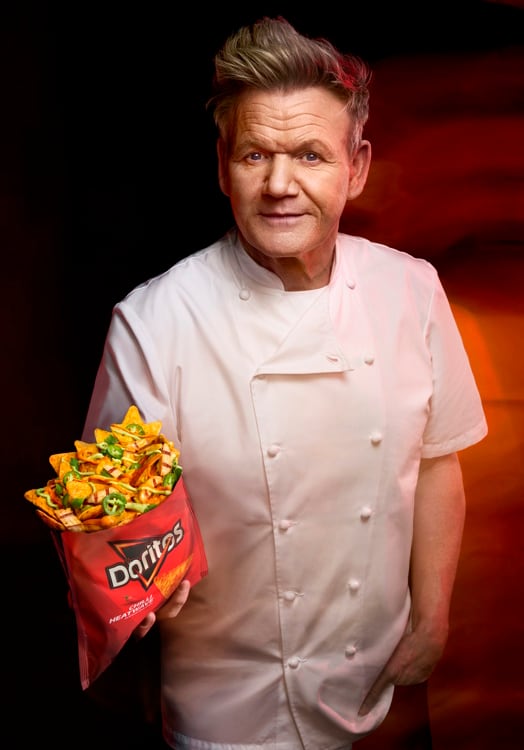
Yet PepsiCo has chosen to place one of the world’s most recognisable chefs at the centre of its latest foodservice push, tasking Ramsay with creating eight Doritos Loaded recipes for restaurants, hospitality operators and Formula 1 fan experiences around the world.
At first glance, it looks like another celebrity endorsement deal. But it also highlights a much bigger shift taking place across the global food industry. The biggest food brands on the planet are no longer searching for awareness; they’re searching for credibility.
At a time when consumers are questioning everything from ultra-processed foods (UPFs) and artificial colours to ingredient lists, health claims and corporate food culture, trust has become one of the industry’s most valuable currencies. Cele chefs offer something traditional advertising cannot easily buy:
- Permission for a snack to become a meal.
- Permission for a chip brand to appear on a restaurant menu.
- Permission for a packaged food company to participate in culinary culture rather than simply sell products.
That helps explain why celebrity chefs are becoming increasingly visible across food marketing strategies.
Food’s new power brokers

Cele chefs have spent decades building businesses around their names and today many operate as global commercial platforms in their own right.
Ramsay’s empire stretches across restaurants, TV, licensing and digital media, with dozens of restaurants operating across Europe, North America, the Middle East and Asia.
Across the pond, Guy Fieri reportedly signed an $80m contract extension with Food Network in 2021 and has transformed his Flavortown brand into a sprawling business spanning restaurants, frozen meals, sauces, seasonings, cruise ship concepts and stadium food partnerships.
Back on Blighty, Jamie Oliver built a global licensing machine covering cookware, books, food products and retail collaborations long before influencer marketing became commonplace.
David Chang has extended the Momofuku brand from restaurants into packaged noodles, sauces and seasonings. Bobby Flay has leveraged decades of TV exposure into restaurants, licensing agreements and consumer products. José Andrés has become one of the most trusted figures in food through a combination of culinary expertise, media visibility and humanitarian work.
These chefs are no longer simply selling recipes. They’re monetising audiences, credibility, content, hospitality expertise and cultural relevance across multiple channels simultaneously.
For brand owners, that combination is becoming increasingly difficult to ignore.
A decade ago, brand owners often looked to celebs from sport, film or music to generate attention. Today, celeb chefs offer something more valuable: authority.
Consumers might enjoy seeing an athlete promote a snack, but they’re far more likely to accept a chef’s view on whether that snack belongs in a meal.
Why snack brands want a seat at the table

The Ramsay partnership reflects another significant shift within the food industry: snack manufacturers are becoming increasingly interested in foodservice.
Historically, a brand’s relationship with consumers ended at the point of purchase. Today, producers are pursuing opportunities that extend far beyond retail shelves.
PepsiCo’s Lay’s brand has branched out into branded restaurants in Spain and culinary experiences in China. Ferrero has developed Nutella Cafés. Oreo has explored branded café concepts and immersive consumer experiences. Mars has invested heavily in destination retail and experiential environments built around M&M’s. Across categories, manufacturers are testing ways to transform packaged goods into ingredients, menu items and dining occasions.
The motivation is easy to understand: retail shelves have become more crowded; price competition remains intense; and private label continues to gain ground. Foodservice offers something different, allowing brands to command premium pricing, create memorable experiences and generate new consumption occasions.
A consumer may purchase a bag of chips once a week. That same consumer might encounter the brand again through a restaurant menu, a food delivery order, a stadium concession stand, a café concept or a hospitality activation. Every additional touchpoint creates another opportunity to build loyalty, drive trial and justify premium pricing.
The more occasions a brand can occupy, the greater the growth opportunity becomes.
The battle for cultural relevance

What makes the Doritos Loaded strategy particularly interesting is that PepsiCo isn’t simply promoting a product but attempting to reposition one.
Doritos has traditionally occupied a straightforward role in consumers’ minds: snack food.
Doritos Loaded asks consumers to think differently. It presents the chip as the foundation of a meal that can be customised, shared and served in foodservice environments.
That leap isn’t as easy as it sounds. PepsiCo has spent decades building consumer understanding of its brands. Rewriting those associations requires consumers to see the brand differently.
A Ramsay-developed menu item appearing in one of his restaurants carries a different weight from a traditional marketing campaign. The same is true when those dishes appear at Formula 1 events, where food, entertainment, hospitality and lifestyle increasingly overlap.
This is where celeb chefs become strategically important, providing a bridge between mass-market products and culinary legitimacy.
From selling products to selling experiences

The Formula 1 component of the Doritos announcement may ultimately prove more revealing than the recipes themselves.
Brand owners have become increasingly focused on experiences because experiences generate engagement, social media content and emotional connection in ways traditional advertising struggles to match. Consumers rarely post supermarket shelves on Instagram (no matter how much a package may ‘pop’). They do, however, share pics of restaurant meals, exclusive events and limited-time activations.
That reality has encouraged brands to think more like hospitality companies and entertainment businesses.
The partnership between Formula 1, Doritos and Gordon Ramsay sits at the intersection of all three. It combines a globally recognised snack brand, one of the world’s most influential chefs and one of the fastest-growing sports properties on the planet.
Viewed through that lens, the collaboration has less to do with nachos than it does with creating cultural relevance.
Why this won’t stop with Doritos
The most revealing aspect of the Ramsay partnership may be what it signals for the wider food industry.
As manufacturers face increasing pressure to justify premium pricing, differentiate themselves from private label and maintain relevance with younger consumers, celeb chefs offer a powerful shortcut into culture, hospitality and foodservice. Today, they’re helping shape restaurant concepts, experiential activations, hospitality strategies and foodservice innovation programmes.
The relationship between food brands and celeb chefs has fundamentally changed.
Twenty years ago, chefs borrowed the scale of multinational food companies to build their own brands. Today, multinational food companies are increasingly borrowing the trust, authority and cultural relevance of celebrity chefs to build theirs.
For an industry looking beyond the supermarket shelf and searching for new ways to remain relevant, that may prove considerably more valuable than another advertising campaign.


