


The heritage brand dilemma, explained:
- Heritage creates enormous brand equity, but the familiar recipes, packaging and rituals that consumers love can also make meaningful change harder.
- Standing still risks losing relevance with new generations, while changing too much can alienate the loyal consumers who built the brand.
- The safest growth often comes from innovating around the icon – using extensions, flavours, formats and collaborations to explore new territory while protecting the core.
There’s a particular kind of corporate courage involved in messing with a product people have eaten since childhood. Change the wrapper and consumers notice; alter the logo and they complain; tinker with the recipe and you might discover that an outdated formulation on a spreadsheet was actually an untouchable piece of someone’s childhood.
Yet standing still carries its own risks. Oreo dates to 1912, Ritz to 1934, Cheerios to 1941, while Nutella and Pop-Tarts arrived in 1964 and McVitie’s roots stretch back to 1839. These brands have survived wars, recessions and supermarket revolutions, but today’s consumer can discover a new snack on TikTok before an established manufacturer has completed its next category review.
There’s serious money riding on the ability to evolve. Kantar’s BrandZ Global Top 100 reached a record $10.7tn in combined value in 2025, while brands that disrupted their categories or successfully reinvented themselves accounted for 71% of the $9.3tn in incremental value created by the ranking since 2006. Innovation clearly pays, although those figures come with a warning for heritage brands: reinvention needs to strengthen the reasons people buy you rather than erase them.
The problem facing brand owners is deciding which parts of an ageing product need refreshing and which have quietly become valuable assets. Younger shoppers need reasons to discover established names, while existing customers expect them to remain familiar. Packaging, recipes, formats, positioning and marketing can all evolve, but the consequences of changing something consumers regard as sacred can be spectacular.
What would consumers miss if it disappeared?
Oreo shows just how elastic a heritage brand can become. Mondelēz International says the biscuit is sold in more than 100 countries and is the world’s top-selling cookie, with variations ranging from blueberry and green tea ice cream to a new limited-edition KFC Spicy Chicken Oreo launched in China.
Yes, fried chicken.
The August 2026 collaboration replaces the familiar crème with KFC chicken-flavoured filling and even swaps some of the traditional biscuit embossing for KFC branding and a chicken drumstick. Online reaction has ranged from curiosity to horror, with some Oreo fans arguing the brand has finally pushed experimentation too far.
That makes it an interesting test of the boundaries of heritage. Oreo can change flavour, colour, filling and cultural context because the underlying product remains immediately recognisable, while the original remains safely on shelf. More than a century of familiarity gives Mondelēz permission to behave in ways a new biscuit brand probably couldn’t.
Other brands have equally powerful cues. KitKat has its fingers and the ritual of breaking them apart, Pringles has its tube and saddle-shaped crisp, Toblerone its triangular chocolate, Goldfish its smiling fish and Ritz its scalloped cracker. The value lies in the collection of visual, physical and behavioural cues that consumers have learnt to associate with the product.
KitKat demonstrates how far that can travel. Launched by Rowntree’s in 1935 as Rowntree’s Chocolate Crisp, it was renamed Kit Kat Chocolate Crisp two years later and has since grown into one of the world’s most recognisable confectionery brands. The Nestlé brand is now consumed in more than 80 countries, with around 17 billion fingers eaten annually and more than 300 flavours developed in Japan alone. Two-finger bars, KitKat Chunky and an extraordinary catalogue of flavours have expanded the franchise, but the fundamental act of snapping off a finger remains. Its ‘Have a break, have a KitKat’ proposition has survived since 1958.
The danger comes when companies mistake familiarity for datedness.
Tropicana discovered that in 2009 after replacing its familiar orange-and-straw packaging with a cleaner design centred on a glass of juice. Sales of Tropicana Pure Premium subsequently fell 20%, according to academic analysis, with researchers estimating that the redesign cost the brand $27m. The company announced a return to its previous packaging within weeks.
Coca-Cola’s New Coke remains the classic formulation warning. After extensive taste testing, Coca-Cola replaced the recipe of its 99-year-old flagship in April 1985, only to encounter such fierce opposition that the original returned as Coca-Cola Classic 79 days later.
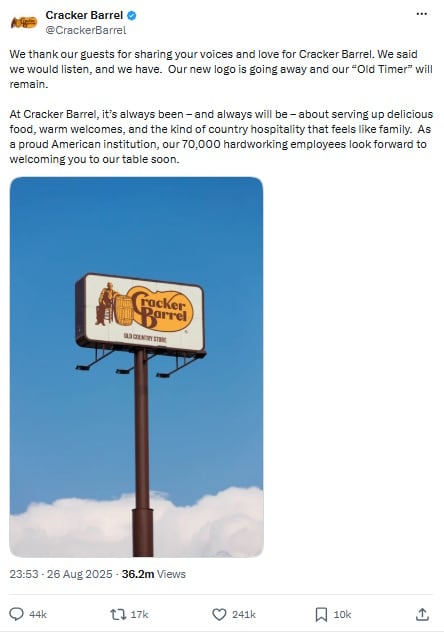
More recently, Cracker Barrel provided an extraordinary demonstration of how quickly consumers can punish a heritage makeover. In August 2025, the US restaurant and retail chain replaced its familiar logo featuring the ‘Old Timer’ sitting beside a barrel with a simplified text design. Shares fell more than 10% following the launch amid a ferocious public backlash, and just eight days later Cracker Barrel announced the old logo was coming back.
“What they did wrong is they went against their brand story, which was the old logo, that reflected the southern, whimsical atmosphere in the stores,” David Johnson, CEO of branding agency Strategic Vision PR Group, told CBS.
Three very different cases point towards the same question that brand owners should answer before touching an established asset: what would consumers miss if it disappeared?
Modernise around the icon
Knowing what to protect doesn’t mean freezing a brand in time but it does give companies somewhere safer from which to experiment.
KitKat has kept the break while changing flavours and formats. Oreo retains the sandwich biscuit while turning almost everything around it into creative territory. Pop-Tarts has moved through new fillings, frostings and collaborations while retaining its familiar rectangular pastry, while Pringles continually rotates flavours without sacrificing the pack and shape that identify it from across the aisle.
Brand extensions can push considerably further. The 2025 Reese’s Oreo collaboration combined two instantly recognisable names and proved so successful that the Reese’s Oreo Cup generated more than $188m in retail sales. Originally an innovation driven by years of consumer requests, the product has subsequently earned a permanent place in the range.
There’s a practical lesson here for companies facing demands to make established portfolios healthier, younger or more culturally relevant. Every new consumer expectation doesn’t have to be forced into the flagship SKU.
Protein, fibre, reduced sugar, portion control and simpler formulations are reshaping food development, while regulatory pressure around sugar, salt, colours and other ingredients is increasing. Reformulating an icon, however, carries risks that developing an extension doesn’t. Reducing sugar can change sweetness and texture, adding protein can affect mouthfeel and increasing fibre can alter structure, while removing familiar colours can change a product before the consumer has even tasted it.
Portfolio extensions offer another route. A high-protein version, smaller format, new flavour or adjacent product can address emerging demand while leaving the product carrying the greatest emotional and commercial equity largely intact.
The same caution applies to the relentless pursuit of Gen Z. Research from global advertising and marketing agency Ogilvy found fewer than 30% of Gen Z respondents felt understood by marketers, while the findings also pointed to digital fatigue and stronger demand for authentic, real-world experiences.
Trying too hard to make a 100-year-old brand look 20 could therefore solve a problem that doesn’t exist. History itself can provide authenticity, particularly when younger consumers are enthusiastically rediscovering retro foods, fashions and cultural references.
Before you touch the logo, recipe or pack
The commercial question ultimately reaches much further than marketing. A packaging redesign can affect shelf recognition, reformulation reaches into R&D, manufacturing and procurement, new formats require production capability, extensions compete for retailer space and limited editions add forecasting, inventory and waste risks.
Constant innovation can also weaken rather than strengthen the masterbrand if consumers stop understanding what it represents. Novelty can attract trial without repeat purchase, while chasing younger shoppers makes little commercial sense if a brand simultaneously alienates the heavy buyers who built it.
That puts the emphasis on incrementality. A successful modernisation should add buyers, occasions or revenue without unnecessarily sacrificing existing ones.
The first task is identifying what consumers believe they’re buying. With Oreo, it could be the sandwich format and ritual; with Pringles, the tube and crisp; with KitKat, the fingers and break; and with a smaller heritage food brand, it might be a particular wrapper, recipe, logo, product name or flavour that has barely changed in 50 years.
Kantar’s finding that reinvention and disruption accounted for 71% of the incremental value created by its Global Top 100 since 2006 makes standing still difficult to defend. The Cracker Barrel, Tropicana and New Coke experiences make indiscriminate change equally difficult to justify. The challenge is knowing the difference between the parts of a brand that have simply become old and those that have become valuable precisely because they are old.
Oreo can put fried chicken between its biscuits and KitKat can produce hundreds of flavours because consumers know exactly where the experimentation begins. The original remains recognisable.
Years of familiarity is something competitors can’t manufacture overnight, which makes understanding what consumers never want you to change just as important as working out what they want next.


