

Ceremonial cocoa explained:
- Ceremonial cacao is minimally processed and traditionally drunk, not eaten – ‘beyond the cup’ is still an open question for NPD.
- Flavanol and cardiovascular benefits are evidenced; emotional or spiritual claims remain anecdotal.
- Growth is steady, not viral – searches are up 12% year-on-year – and the real opportunity is education and traceability, not just scale.
Forget everything you think you know about cacao as a raw material. This isn’t a bean waiting to be optimised for consistency, shelf life and unit cost. Ceremonial cacao is succeeding precisely because it refuses to behave like a conventional ingredient category, and it’s about to force some uncomfortable questions on anyone in bakery, confectionery or drinks development who assumes ‘cacao’ and ‘cocoa’ are interchangeable.
Ceremonial cacao is stone-ground into a paste from whole, minimally processed cacao beans, rather than the roasted, alkalised and defatted route commodity cocoa takes on its way to a chocolate bar. It’s traditionally traded whole-farm or whole-community, so the finished paste can be traced back to a single origin rather than a blended lot. Most of it is still drunk – melted into hot water and whisked, in a ritual with roots in Central and South American Indigenous cultures – rather than eaten, which is exactly why the industry is now asking whether it can move beyond the cup at all.
The science backs some of the hype, but not all of it. Flavanol-rich cacao has genuine, evidenced links to blood flow, cardiovascular health and cognitive performance. The spiritual-awakening claims doing the rounds online are a different matter. Search interest in ceremonial cacao grew 12% over the past year, putting it at around 30,000 searches a month, and the conversation is concentrated on Instagram rather than TikTok, where visual, ritual-heavy content travels furthest. Google Trends data shows search interest for ceremonial cacao powder peaking in September, December and January, with ceremonial cacao beans spiking separately in November – a seasonal pattern that tracks with new-year routines and short, dark days rather than any single viral moment. Yes, real momentum, but momentum that’s built largely on personal testimony rather than clinical trials.
Steve Gravener knows that gap better than most. He’s the founder of UK-based Pachakuti Cacao, sourcing heirloom Arriba Nacional cacao direct from farming communities in Ecuador, and he’s watched the category go from total obscurity to something approaching mainstream curiosity in a handful of years. His insight is a useful gut-check for an industry that’s working out what to do with this ingredient at scale.
Where the science actually holds up and where it doesn’t
The evidence bar for wellness claims keeps climbing, and Gravener holds cacao to the same standard. “There is good scientific evidence that cacao is rich in flavanols, which have been shown to support healthy blood flow, including to the brain,” he says. “Studies have also linked regular consumption of high-flavanol cacao with improvements in cardiovascular health and some aspects of cognitive function, particularly attention and mental performance. Cacao is also naturally rich in magnesium and contains compounds such as theobromine, which provides a gentler, longer-lasting stimulation than caffeine.”
The problem for formulators is what can legitimately be promised on-pack. “Where the evidence becomes less definitive is around claims that ceremonial cacao creates profound emotional breakthroughs or spiritual experiences,” he says. “Many people genuinely report feeling calmer, more connected, more creative or emotionally open after drinking ceremonial cacao, but these experiences are largely anecdotal and are difficult to measure scientifically. The setting, intention, mindfulness practices and the social environment often play an important role alongside the cacao itself.”
Pachakuti draws the line at turning those personal experiences into scientific promises. “We’re careful not to overstate the science,” says Gravener. “We focus on what the evidence supports – such as cacao’s naturally occurring flavanols, minerals and bioactive compounds – while recognising that each person’s experience is unique.” Translation for anyone building a claims strategy: the flavanols and minerals will stand up to scrutiny; the transcendence narrative won’t.
Coffee is the obvious comparison, but he pushes back on suggestions that consumers are simply swapping one drink for the other. “I don’t think people are necessarily replacing coffee altogether – many still enjoy both. Coffee is often associated with a quick boost in energy, whereas ceremonial cacao offers a gentler, more sustained experience. Because cacao contains theobromine rather than large amounts of caffeine, many people describe feeling focused and alert without the jitters or sudden energy crash they sometimes experience with coffee.” It’s less a substitution story than an occasion story: two drinks doing two different jobs at two different points in the day.
Beyond the cup: where the real opportunity sits

Given that ceremonial cacao is still overwhelmingly consumed as a whisked drink, the obvious question for anyone in bakery, confectionery or snacking is whether it works beyond the cup at all.
“I think there are exciting opportunities for ceremonial cacao beyond the traditional drinking ritual,” enthuses Gravener. “As consumers become more interested in natural ingredients and functional foods, we’ll almost certainly see more premium chocolate, snacks, bakery products and other innovations using high-quality cacao.”
The potential is there, although Gravener’s answer stops short of presenting ceremonial cacao as an easy route into functional NPD.
“Commercially, I think the biggest opportunity isn’t simply putting ceremonial cacao into more products – it’s helping consumers understand the difference between highly processed cocoa and authentic ceremonial cacao.” Gravener’s not talking about volume but about educating the consumer – and any manufacturer that treats ceremonial cacao as a drop-in cocoa substitute, without explaining why it’s different, will torch the exact provenance story that made shoppers pick it up in the first place.
Protecting that story starts further up the supply chain. “We work directly with trusted partners in Ecuador who share our values around sustainability, transparency and respect for traditional growing methods,” he says, noting, “We pay above Fairtrade rates because we don’t believe the value created in Western markets should stop once the cacao leaves the farm.” It’s a relationship-led sourcing model, not a commodity one – and it’s the same template dairy, honey and specialty tea brands are increasingly being held to as well.
Can ceremonial cacao scale without losing its soul?
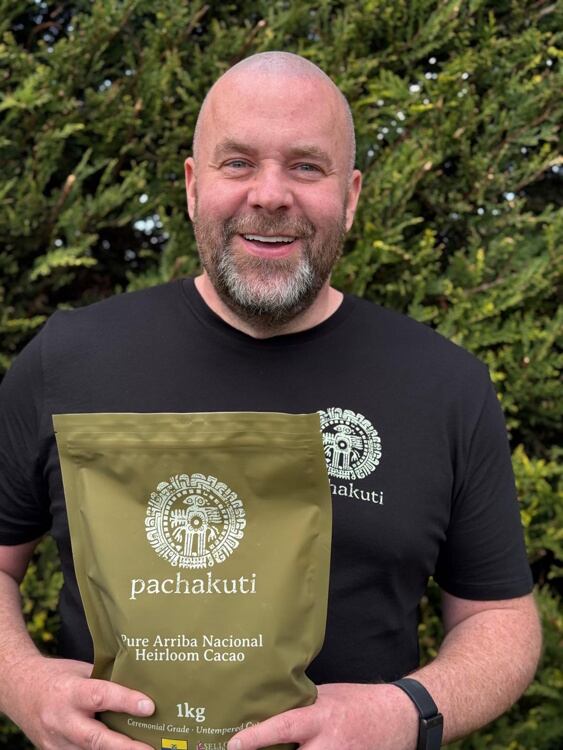
Asked where the industry gets it wrong, Gravener contends: “”I think the biggest misunderstanding is that ceremonial cacao is simply another form of cocoa. It isn’t. Nor is it a hot chocolate drink. The food industry has spent decades optimising cacao for consistency, efficiency and large-scale manufacturing, whereas ceremonial cacao is valued for almost the opposite reasons – its origin, its minimal processing, its flavour, its natural composition and the story behind it.”
That’s a direct hit on every manufacturing process built around standardisation. Consistency is the entire point of large-scale cocoa processing – blending beans across origins and harvests so every batch tastes the same. Ceremonial cacao rejects that logic outright: single farm, single harvest, deliberately unblended. Scale one up without scaling down what makes it ceremonial in the first place, and the product stops being ceremonial cacao at all.
On where this is heading, Gravener believes “manufacturers will be surprised by how much consumers care about provenance and transparency. I also think we’ll see ceremonial cacao move from being viewed as a niche wellness product to being recognised as a premium food ingredient in its own right. Much like specialty coffee transformed people’s expectations of coffee, I believe ceremonial cacao will change the way people think about chocolate and cacao more broadly.
“The biggest surprise for manufacturers won’t simply be the growth of ceremonial cacao – it will be that consumers are no longer buying products on price alone. They’re buying trust, authenticity and values. In five years time, I don’t think the companies with the biggest marketing budgets will necessarily win. I think the companies with the greatest transparency will.”
Whether a claim that bold holds up depends on what happens next. Ceremonial cacao is small enough right now that its provenance claims can still be checked by hand and its supply chains still traced farm by farm. The real test comes when demand outstrips the number of communities able to supply heirloom, minimally processed cacao at ceremonial grade. At that point, the industry will have to decide how much it’s willing to invest in keeping pace with demand without losing what makes the category distinctive in the first place.
Gravener’s bet is the businesses that hold the line on transparency will be the ones still standing.
Studies:
Jumar A, Schmieder RE. Cocoa Flavanol Cardiovascular Effects Beyond Blood Pressure Reduction. J Clin Hypertens (Greenwich). 2016 Apr;18(4):352-8. doi: 10.1111/jch.12715. Epub 2015 Oct 30. PMID: 26514936; PMCID: PMC8031944.
Martín MA, Goya L, de Pascual-Teresa S. Effect of Cocoa and Cocoa Products on Cognitive Performance in Young Adults. Nutrients. 2020 Nov 30;12(12):3691. doi: 10.3390/nu12123691. PMID: 33265948; PMCID: PMC7760676.
Katz DL, Doughty K, Ali A. Cocoa and chocolate in human health and disease. Antioxid Redox Signal. 2011 Nov 15;15(10):2779-811. doi: 10.1089/ars.2010.3697. Epub 2011 Jun 13. PMID: 21470061; PMCID: PMC4696435.


