


Key takeaways:
- Time’s list captures companies driving momentum through expansion and acquisition, but not always those reshaping how the industry operates.
- The biggest shifts in food right now are being driven by health trends, digital platforms and retail dynamics that sit beyond traditional food players.
- Real disruption is increasingly about changing consumer behaviour – how we eat, shop and discover food – rather than simply scaling existing models.
When Time unveiled its latest list of the 10 most influential food and drink companies, it positioned the selection as a snapshot of businesses setting the pace through impact, innovation, ambition and success. It’s a broad brief that leans heavily on editorial judgement, and one that inevitably reflects what’s most visible in the market at any given moment.
The New York-based publication has never claimed to rank companies using a rigid methodology. Its lists are curated, shaped by reporting, expert input and perspective. That also means they tend to favour companies making visible moves – acquisitions, partnerships, expansion – over those driving less obvious, but still fundamental, change.
What you get, then, is a picture of momentum: companies growing, entering new categories or building out platforms. What you don’t always get is a clear view of the forces shifting how the industry actually works, or how quickly those shifts are feeding through into everyday behaviour.
And that’s where things start to diverge. Right now, food isn’t only being shaped by the companies inside it: it’s being pulled in new directions by health trends, retail dynamics and digital platforms – and those don’t always show up neatly in a ranking.
Inside Time’s picks

Time’s list isn’t short on momentum. Ferrero Group makes the cut for good reason: its steady run of US acquisitions, culminating in a move into breakfast cereals, shows a company actively reshaping its role in the market. The Italian confectioner is broadening its reach across eating occasions, moving beyond treats into more everyday consumption moments.
Mixue Group’s scale is one thing, but the real story is its model. By prioritising affordability and dense store networks, the Chinese drinks-and-desserts chain – now the largest foodservice player globally by outlet count (45,000+) – has demonstrated an alternative path to growth that doesn’t rely on premiumisation, particularly in emerging and price-sensitive markets.
Digital restaurant booking platform OpenTable earns its place on reach and data. With millions of diners flowing through the platform, it still sits at the centre of the reservations ecosystem, giving it a level of visibility into consumer behaviour that few others can match, even as rivals like American Express-owned Resy push in.
Farmer’s Fridge is included for its take on convenience, using logistics and data to make fresh food more accessible in high-traffic locations. Founded in 2013 by Luke Saunders, it set out to make healthy food as easy to grab as a chocolate bar, and has scaled that idea into a network that blurs the line between vending, retail and foodservice.
Wonder is perhaps the most ambitious inclusion. The US-based platform is trying to collapse the gap between restaurant, kitchen and delivery app, using centralised, tech-enabled kitchens to produce meals from multiple brands and chefs, then dispatch them within minutes. Its acquisition of Grubhub, alongside earlier deals for Blue Apron and others, signals its intent to control the entire food journey, from production through to delivery.
Celsius Holdings reflects a shift driven by changing consumer priorities. Its positioning around functional energy – sugar-free, vitamin-enhanced, wellness-adjacent – has helped it carve out a distinct space. The $1.8bn acquisition of Alani Nu underlines how quickly that segment is evolving, particularly among younger consumers.
Jollibee earns its place on sustained global expansion. Long dominant in the Philippines, the fast-food restaurant brand – best known for its take on fried chicken and Filipino-inspired comfort food – is now scaling rapidly in North America and beyond, without diluting its identity.
Pairwise sits further up the value chain, but its inclusion points to the growing importance of agricultural innovation. The North Carolina-based company is using CRISPR gene-editing tools to develop crops with specific traits, with partners including Mars and Bayer, signalling how upstream changes can shape what eventually reaches shelves.
Fishwife taps into a cultural shift driven by social media. The Los Angeles-based brand has been closely linked to the resurgence of tinned fish on platforms like TikTok, where the category has found a younger audience. Its bold packaging and collaborations have helped reposition a once-overlooked staple into something more lifestyle-driven.
David Protein rounds out the list, riding the surge in demand for high-protein products. The brand has grown quickly off the back of that obsession, reaching a valuation of around $725m within its first year, even as disputes over ingredients, labelling and its acquisition of key inputs continue to follow it.
Our top 10 disruptor picks
To build a more complete picture, we looked beyond corporate activity and focused on a different question: which companies or platforms have materially changed how food is produced, sold or consumed over the past year. That meant prioritising three criteria: measurable impact on behaviour, evidence of forcing industry response, and momentum over the past 12 to 18 months.
That immediately brings Novo Nordisk into focus. Its GLP-1 drugs are now being linked to reduced calorie intake and changing snacking habits, with early US retail data suggesting fewer high-calorie, impulse purchases – a shift that could ripple across multiple packaged food categories.
At the same time, TikTok has become a powerful force in food innovation. Viral formats such as ‘girl dinner’ and high-protein trends show how quickly behaviour can shift, often translating into real-world sales spikes. That has shortened the distance between trend and product, with brands forced to move faster and rethink how they develop and launch products.
Retail continues to reshape the landscape. Aldi has strengthened private label to the point where it now sets the benchmark on value. This is underscored by Kantar data, which shows own-label accounting for more than half of grocery sales in several European markets, putting sustained pressure on branded manufacturers to justify price and positioning.
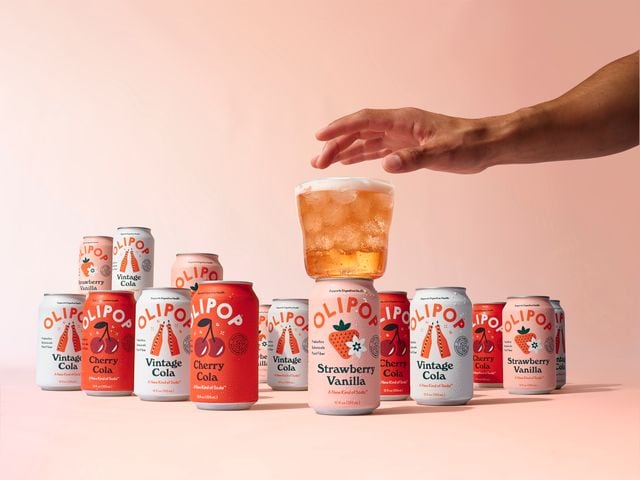
Olipop is redefining what a soft drink can be, combining familiar formats with gut-health positioning and pushing larger players to explore similar claims as consumer expectations shift.
Sustainability is taking on a more commercial edge. Too Good To Go has scaled a model that turns surplus food into a consumer proposition. Now active in more than 20 countries, it shows waste reduction can be embedded into everyday purchasing behaviour rather than treated as a back-end issue.
Oatly is notable because it marks a turning point for the plant-based sector. After years of rapid expansion, growth has slowed, prices are under pressure and consumers are asking harder questions about processing and nutrition. The Swedish alt-dairy producer has adjusted operations, but softer demand signals a category that now has to compete on taste, nutrition and value.
Further upstream, Perfect Day continues to push alternative protein production forward, pointing to longer-term shifts in how ingredients are produced and how supply chains might evolve.
Even outside traditional food, boundaries are blurring. Shein’s move into food-adjacent experiences reflects its push into physical retail and a wider convergence between retail, lifestyle and dining, particularly among younger consumers.
Magic Spoon has helped reposition breakfast cereal as a go-to high-protein, low-sugar product, targeting consumers who want indulgence without compromise. Built as a digital-first brand, it’s used direct-to-consumer channels and influencer marketing to grow quickly, while pushing established players to rethink both formulation and positioning in a category long defined by sugar and nostalgia.
Rounding out the list is US bakery café chain Crumbl Cookies, which has built rapid growth on a rotating weekly menu and strong social media presence, turning product drops into events that drive repeat visits and reshape expectations around what a bakery brand can be.


