


The challenges of snack innovation explained
- Tantos developed a proprietary puffing process and bespoke pasta shape to bring its semolina-based chips to commercial scale.
- Tantos has sold more than 600,000 bags and secured distribution in over 1,000 US retail outlets following its Shark Tank appearance.
- Specialist equipment, production costs, retailer deductions and sales velocity present significant challenges when creating an entirely new snack category.
The Sharks weren’t biting when chef Joe Sasto and entrepreneur Sean Knecht appeared on Shark Tank in November 2025. The duo hoped to convince investors that pasta deserved a place in America’s snack aisle, but they left without a deal. Viewers, however, had a different idea.
Around 3,000 orders flooded in over the following three to four days. Online sales have since remained at three to four times their pre-broadcast level, and the momentum hasn’t disappeared now that the cameras have moved on. California-based Sasto Snacks has sold more than 600,000 bags of Tantos and secured distribution in over 1,000 US retail outlets.
The concept sounds almost ridiculously simple: take real pasta, puff it into an airy, melt-in-your-mouth crisp and season it with Italian flavours. Yet behind that idea lies a manufacturing headache involving expensive bespoke equipment, unpredictable production runs and the challenge of convincing shoppers that a pasta chip isn’t simply a potato crisp dressed up with Italian seasoning.
The format being unfamiliar means you cannot borrow anyone else’s supply chain playbook. We had to learn and adapt on the fly.
Sean Knecht, cofounder and CEO, Sasto Snacks
It’s an interesting case study for an industry constantly hunting for the next big thing. Innovation might win headlines and open retailers’ doors, but getting shoppers to understand an unfamiliar product and come back for more takes considerably more work. As CEO Knecht has discovered that being first into a category brings opportunities that established brands rarely enjoy, along with complications they rarely encounter.
The problem with inventing something nobody’s made before
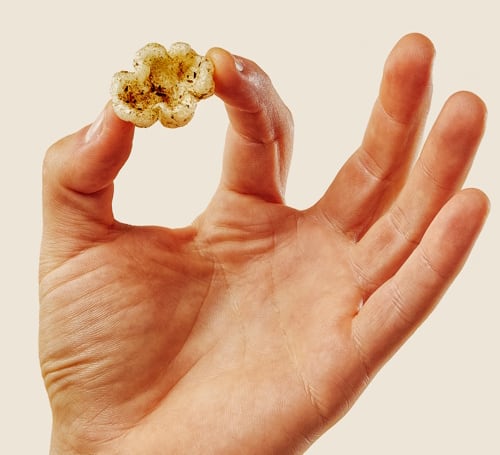
Launched in July 2024, Tantos brings together Sasto’s culinary experience as a Top Chef finalist and Knecht’s entrepreneurial background. The pair set out to create something entirely new for the snack aisle, developing what they claim is the world’s first and only puffed pasta chip.
“Tantos is actual pasta turned into a chip: 100% semolina, puffed to perfection, and seasoned with real Italian ingredients,” says Knecht. “Everything else sold as a ‘pasta chip’ is a cracker or potato/corn chip shaped like pasta or in pasta flavours.”
The pair even invented a pasta shape, fioregato, combining the Italian words for flower and folded. Designed specifically for puffing, it produces a chip sturdy enough for dipping but lighter than a conventional fried crisp.
Turning that kitchen experiment into a commercially viable product proved considerably harder. Early production involved three processing stages, which the founders needed to reduce to two to make scaling feasible. Their solution was a proprietary puffing method that Knecht is understandably reluctant to reveal.
A specialist die also had to be manufactured in Italy, at considerable expense, taking several months to arrive. Rather than investing in their own factory, Sasto Snacks partnered with a specialist co-manufacturer capable of handling both pasta production and snack finishing.
However, minimum order quantities were high, and allergen-management requirements meant all four flavours had to be manufactured together. That left Tantos carrying substantial inventory while still establishing demand. Production takes approximately three weeks, excluding freight, because the company isn’t yet large enough to justify its own dedicated line.
“The format being unfamiliar means you cannot borrow anyone else’s supply chain playbook. We had to learn and adapt on the fly,” says Knecht.
Developing something genuinely different can attract buyers and create new opportunities, but unfamiliar manufacturing processes, specialist equipment and demanding production schedules bring additional costs that need to be carefully managed as the business scales.
Beyond the Shark Tank hype
Knecht already knew what television exposure could do for a young business. He’d previously appeared on Shark Tank in 2016 with PrideBites, a pet products business he co-founded, giving him some idea of the demand a national broadcast could generate.
He was hoping for another successful outing with Tantos, this time seeking $150,000 in exchange for a 10% equity stake. But the Sharks weren’t convinced, even questioning whether the fledgling brand could hold its own against established snack manufacturers.
And having experienced the programme’s commercial impact with PrideBites, Knecht ordered additional Tantos inventory ahead of the broadcast, despite receiving only three weeks’ notice of the air date. It was a gamble: underestimating demand could mean disappointing thousands of potential customers, while overestimating it could leave the business sitting on expensive stock.
His instincts proved sound, with Tantos fulfilling 99% of orders on time. “The broadcast brought roughly 3,000 orders in three to four days and e-commerce has held at three to four times the pre-show baseline since.”
Sasto Snacks generated approximately $225,000 in revenue between July and December 2024, rising to around $750,000 in 2025. Its cumulative sales have since exceeded 600,000 bags, suggesting the product is finding an audience beyond its initial television exposure.
Interestingly, its bestseller isn’t necessarily the flavour American consumers would be expected to recognise most readily. Cacio e Pepe, inspired by the Roman pasta dish of cheese and black pepper, accounts for 45% of all bags sold. Pesto follows at 22%, Marinara at 21% and Classico at 12%.
“Curiosity buys the first bag, a flavour ranking like that only happens when people come back,” says Knecht.
Although flavour preferences don’t independently establish repeat-purchase rates, they do suggest shoppers are willing to experiment with something beyond the familiar tomato-based options.
Convincing them to try pasta chips in the first place remains another challenge. But thankfully, “more than you think and less than you fear,” says Knecht when asked how much explanation an unfamiliar snack needs. He explains that shoppers often assume they’re looking at potato crisps with Italian seasoning. Instore sampling has therefore become particularly important for Tantos.
“At demos, brand awareness is near zero but conversion once someone tastes it is the strongest signal we have. The product is not the problem; reach is.”
Finding the right supermarket shelf has also involved experimentation, with Tantos appearing in snack aisles, deli sections and even alongside conventional pasta. Each offers a different opportunity, but the challenge is finding where shoppers are most likely to discover the product, understand its appeal and give it a try.
Winning the shelf space battle

Tantos is now stocked in more than 400 Kroger stores and over 1,000 retail outlets nationally, including H-E-B, The Fresh Market, Fresh Thyme and World Market. But Knecht knows that getting listed is only half the battle.
“The measures that matter to buyers are scan data and units per store per week (aka velocity). Everything else is a story, those are the evidence.”
Specialty and natural retailers have delivered the strongest sales velocity, with their customers generally more receptive to unfamiliar products. Tantos is consequently focusing promotional spending on its 4oz retail packs, supported by quarterly promotions, digital coupons, Instacart activity and in-store demonstrations.
Knecht admits he’d approach several aspects of the business differently if starting again, particularly pricing, distribution and retailer selection.
Understanding how retailer and distributor deductions affect profitability is essential, he says, as is learning how brokers, sales representatives and distributors operate. He’s also become more selective about pursuing accounts that genuinely move product rather than chasing distribution numbers for their own sake.
Being different does, however, have its advantages. Knecht says the novelty of Tantos has helped attract media attention and opened doors with retail buyers. And without a directly comparable product on the shelf, there’s no established competitor setting shoppers’ price expectations.
“Press and buyers take the meeting and there’s no incumbent to price against.”
But originality comes at a price. “You educate every single shopper from zero, there are no category velocity benchmarks to borrow and no supplier has done your format before, so every answer costs real money to learn,” he adds.
It’s an important consideration for manufacturers developing unconventional snacks. Being first can provide a valuable head start, but it also means shouldering the costs of educating consumers, developing manufacturing processes and convincing retailers that an entirely new proposition deserves space.
Tantos has already demonstrated considerable commercial traction, and its expansion into mainstream grocery suggests the pasta chip is becoming more than a culinary curiosity.
Looking back, Knecht admits there are things he’d do differently, particularly when it comes to pricing, distribution and choosing the right retail partners. And given the expense of developing specialist equipment, managing production runs and building a new snack category, he has one final piece of advice. “I’d try to raise more money than I did.”
Given the cost of turning an unfamiliar idea into a nationally distributed snack, it’s probably advice worth taking seriously.


