


Bakery decoration automation explained:
- Edible printers and vision-guided icing systems are making personalised toppers and decorated cookies more viable at scale.
- Purpose-built food printers offer stronger hygiene controls than converted consumer inkjet machines, but inks must still meet local regulations.
- Automation can improve consistency and reduce repetitive labour, although intricate finishing and creative judgement remain human strengths.
Connie prints edible frosting sheets. Freddie pipes and floods royal icing. Eddie applies images directly to cookies and confectionery. The playfully named systems from Minnesota-based Primera Technology reflect the steady movement of bakery decoration from the piping bag to digitally controlled machinery.
Mixing, depositing, shaping, baking and packing have been automated extensively, while decoration has remained dependent on manual skill. Cakes and cookies vary in shape, toppings behave unpredictably and elaborate finishes require precision that conventional production equipment has struggled to reproduce.
Cameras, sensors and edible printing are starting to overcome those limitations. Digital printers can change a design without altering the product beneath it, while vision-guided systems can adapt their movements to individual cookies instead of assuming that every baked item is identical.
Custom cake toppers, full-sheet wraps and personalised cupcake images can be among a bakery’s highest-margin add-ons, according to Primera. These decorative tricks can transform a standard bakery base, but they frequently rely on repetitive, highly precise manual work. Automation could bring greater consistency, reduce physical strain and make short, personalised runs commercially viable. It also raises questions about food safety, investment and whether a mechanically perfect finish can carry the same value as visible human craft.
From converted office printers to food machinery

Edible printing has existed for years, with many bakeries using modified consumer inkjet printers filled with edible inks. Those machines were originally designed to put conventional ink onto paper rather than operate alongside food in a commercial kitchen.
Newer systems are being developed specifically around edible materials, cleanability and food-contact requirements. Primera says its Connie sheet printer uses food-contact materials throughout the ink and sheet pathway, stainless-steel construction and cartridges filled in a cGMP-certified facility.
Primera says Connie is the first edible sheet printer in its category to secure NSF certification for commercial kitchen use. The NSF’s official product database now lists two Connie models under its standard for manual food and beverage dispensing equipment.
Food-safe ink alone doesn’t settle whether a printing process is suitable for commercial production. Bakeries must also consider the surfaces touched by the ink, the ease of cleaning internal components and whether the colours comply with local regulations. Primera offers different edible ink formulations for North America and Europe, demonstrating how requirements can vary between markets.
Digital vision extends automation beyond printing. Baked products spread, shrink and warp, meaning a fixed piping programme could miss part of a cookie or send icing over its edge.
Freddie photographs each cookie and plots its outline before piping and flooding it with royal icing. This allows the machine to adjust to variations instead of requiring every product to arrive in precisely the same shape and position.
However, automation doesn’t remove the need for production control. Royal icing still requires the correct consistency, while cookies must remain within the machine’s size and surface limits. Nozzles can block, colours must be changed and equipment needs cleaning.
The speed advantage isn’t automatic either. Freddie takes approximately one minute to ice a cookie, which may not outperform an experienced decorator handling a simple design. Its case rests more heavily on consistency, reduced physical strain and the ability to complete repetitive work with less supervision.
Can automation preserve the value of craft?
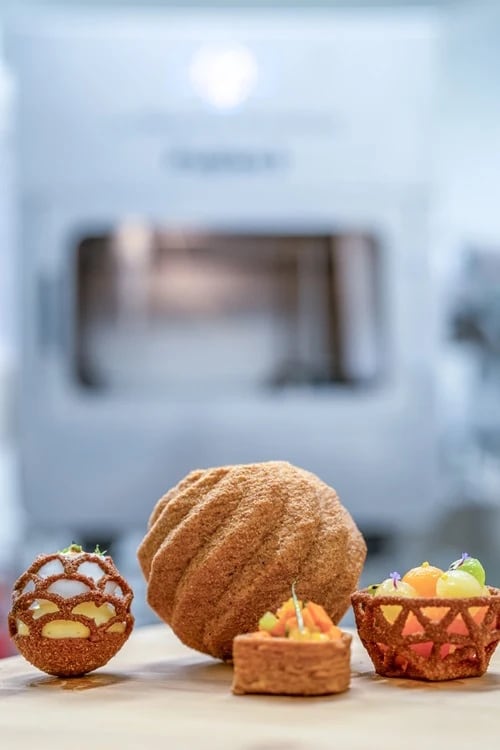
France’s Maison Bécam has taken digital production beyond surface decoration by installing a Patiss3 food printer, developed by La Pâtisserie Numérique, to create intricate pastry and cake structures.
The system deposits a liquid preparation into a supporting wheat powder. Once the product has been baked, the surrounding powder is removed to reveal forms including stars, spirals and lace-like patterns that would be difficult to reproduce repeatedly by hand.
“This is going to open up doors on cake design that we cannot manage by hand,” Maison Bécam founder Nicolas Bécam told French broadcaster Télé Angers. However, the printer doesn’t produce a finished patisserie; bakers must still develop the recipe, fill the structure and complete the decoration.
This separation between automated repetition and human judgement may define how the technology is adopted. Printing hundreds of identical logos or flooding cookies with one colour requires time and precision but offers limited creative satisfaction. Removing that work could allow decorators to concentrate on sculpted details, finishing and original designs.
Digital decoration could also make personalisation practical at greater scale. A manufacturer could use the same biscuit and icing while changing the name, photograph, message or retailer logo printed on each batch. Designs become digital files rather than separate recipes or manually produced toppers.
That flexibility introduces another type of quality control. Customer-supplied images must be checked for resolution, spelling, copyright and unsuitable content before they reach the production line. A digital error can still result in rejected food and wasted ingredients.
Equipment, inks, maintenance, training and downtime must also be measured against realistic order volumes. A printer capable of producing personalised products has limited commercial value if demand is too low or irregular to keep it operating.
Bakery decoration is unlikely to become entirely automated. Machines are better suited to repeated outlines, uniform floods and identical images than to the final adjustments and creative decisions made by an experienced decorator. Connie, Freddie and Eddie show how much of the process can now be digitised, while also making the remaining human contribution easier to identify.