


The avo oil story: overview
- A UC Davis study found 89% of tested products listing avocado oil as their sole edible oil had inconsistent compositions
- Snack brands are embracing avocado oil for its premium health positioning and frying performance, despite its higher cost and technical challenges
- The anti-seed-oil movement is accelerating demand, but weak oversight and authenticity concerns could undermine consumer trust
Avocado oil has become one of the snack aisle’s most marketable ingredients. It can make an everyday bag of crisps appear cleaner, healthier and more premium. Siete, Jackson’s, Good Health, Snacklins and Boulder Canyon have all built products around it, while PepsiCo is taking avo oil further into the mainstream with Lay’s Kettle Cooked Reduced Fat chips.
That health halo has now come under scrutiny.
Utz Brands is facing a proposed class action over its Boulder Canyon Avocado Oil Classic Sea Salt Kettle Style Potato Chips, which list only potatoes, avocado oil and sea salt. Plaintiff Ezekiel Schultz alleges the oil was substituted or diluted and claims shoppers wouldn’t have bought the crisps, or would have paid substantially less, had they known.
Days later, California resident Diana Heiland filed a proposed class action against Campbell’s over Kettle Brand Avocado Oil Sea Salt with a Hint of Pink Peppercorn Potato Chips. The complaint alleges the product was marketed as ‘Made with Avocado Oil’ but testing showed a composition associated with cheaper refined seed oils. Heiland claims she bought the crisps because she avoids seed oils and believed avocado oil was the only oil used.
Neither case has been tested in court, and the claims remain allegations. However, both complaints draw on a University of California, Davis study that found almost nine in 10 samples from processed foods declaring avocado oil as their only edible oil had fatty-acid and sterol profiles inconsistent with the authentic ingredient.
The Campbell’s complaint identifies the Kettle Brand product it says was tested, alleging that UC Davis examined two production lots in duplicate. Every sample was classified as compositionally inconsistent with authentic avocado oil, while the recovered oil allegedly carried the signature of refined vegetable oils.
Utz has yet to comment, while Campbell’s has declined to discuss pending litigation.
Inside avo oil’s authenticity crisis

Published in Applied Food Research, the study examined oils extracted from 74 commercially available chips, mayonnaises and salad dressings. Fifty-four samples represented two production lots from 27 products listing avo oil as their sole edible oil.
Of those 54 samples, 48 (or 89%) produced compositions inconsistent with authentic avocado oil. The problem appeared in 93% of the chip samples, 71% of the mayonnaise samples and every salad dressing sample. Among 20 products listing olive oil as their only oil, just one returned an inconsistent result.
These weren’t foods openly declaring canola, sunflower or soybean oil alongside a smaller quantity of avocado oil. Every product selected for this part of the research listed avo oil as the only edible oil in its formulation.
“Consumers are increasingly paying a premium for products made with avocado oil or olive oil,” said lead author Selina Wang, professor of cooperative extension in the UC Davis Department of Food Science and Technology. “They deserve to get what they pay for and food manufacturers deserve confidence that the ingredients they purchase from suppliers are authentic.”
Although Primal Kitchen wasn’t named in the study, founder Mark Sisson responded after the findings triggered online speculation about which brands might be affected. Describing the resulting discussion as a “barrage of misinformation and innuendo”, he insisted Primal Kitchen uses ‘100% pure avocado oil’ and never blends it with seed oils.
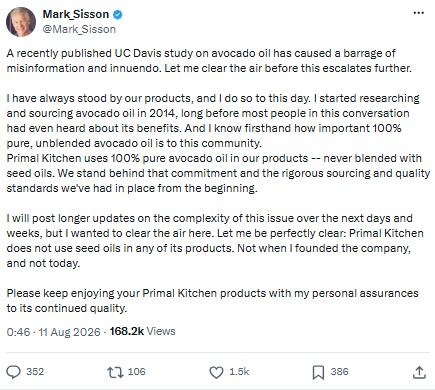
His intervention shows how quickly an anonymised study can cast suspicion across an entire category. The findings don’t establish that manufacturers behind inconsistent samples deliberately replaced the declared ingredient. As the authors acknowledge, a producer could have bought what it believed was authentic avocado oil without knowing it had already been diluted or substituted further upstream.
Olive oil has faced decades of adulteration scandals, scientific investigation and tighter monitoring. Avocado oil is newer, more expensive and less standardised, creating greater opportunities for substitution – and a powerful financial incentive to do it.
Why snack brands are buying in
Avo oil initially gained traction among wellness-positioned brands targeting shoppers prepared to study ingredient lists and pay more to avoid conventional vegetable oils.
Siete uses it across tortilla and potato chips, while Jackson’s cooks its sweet potato chips in avocado oil. Snacklins promotes vegetable crisps cooked in 100% avo oil, and Good Health and Boulder Canyon have also made it central to their positioning. In 2026, Khloé Kardashian’s Khloud joined them with protein crisps using avocado oil instead of traditional seed oils.
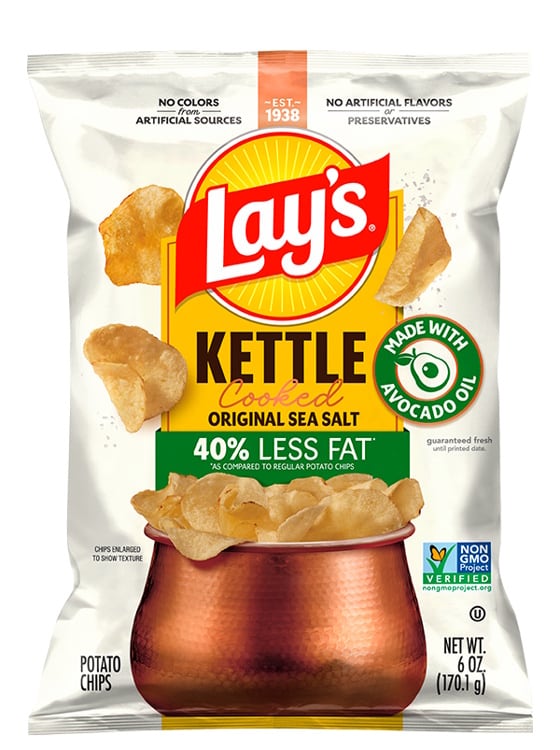
Lay’s brought the ingredient into a mass-market portfolio with its Kettle Cooked Reduced Fat Original Sea Salt crisps. Made with avo oil, the product promises 40% less fat than regular potato chips. What started as a point of difference for natural-channel brands is now being used by one of the world’s largest snack portfolios.
Investment further up the supply chain suggests this isn’t simply a social-media fad. Fresh Del Monte acquired a majority stake in Ugandan producer Avolio in 2025. At the time, it valued the global avocado oil market at approximately $1.2bn, with annual growth of 8% to 10%, and announced plans to scale Avolio’s technology to process 140 tonnes of avocados a day.
There’s also a useful waste-reduction story. Avocados that can’t be sold whole because of their appearance, size or ripeness can be turned into oil rather than discarded.
The technical case is credible, too. Refined avo oil has a neutral flavour, high smoke point and fatty-acid profile rich in monounsaturated fat. Research has found it can remain stable during frying, although performance depends on the grade, refining process, storage conditions and food being produced.
However, moving it onto an industrial line isn’t as simple as changing one ingredient. Manufacturers need predictable flavour, colour and frying behaviour from every delivery. Virgin avocado oil can carry green, grassy or buttery notes, while refining creates a more neutral product but can remove some of the pigments and antioxidants supporting its natural-health image.
Temperature, oxygen, fryer turnover and moisture also affect oil degradation, so manufacturers may need to reassess filtration, frying conditions, packaging and shelf life. The UC Davis findings add authenticity to that checklist. Without established industry standards, manufacturers may need independent testing to confirm that the oil entering the fryer matches what appears on the packet – particularly now that the research has triggered proposed class actions against two major snack companies.
RFK Jr’s $5 avocado oil problem
Avocado oil’s rise is closely tied to the increasingly vocal backlash against seed oils. Canola, corn, cottonseed, soybean, sunflower, safflower, grapeseed and rice bran oils have been recast online as an industrial threat, often grouped together as the ‘hateful eight’. US health secretary Robert F Kennedy Jr has pushed that argument into mainstream politics by repeatedly linking them to chronic disease.
The evidence doesn’t support many of the movement’s strongest claims. Nutrition researchers at Johns Hopkins have said seed oils don’t cause inflammation, while the American Heart Association maintains that omega-6 polyunsaturated fats can help reduce LDL cholesterol when they replace saturated fat. Avoiding seed oils may prompt people to consume fewer energy-dense ultra-processed foods (UPFs), but that doesn’t prove the oils themselves are uniquely harmful.
Consumer perception, however, is moving faster than the science. Because avocado oil comes from fruit flesh, contains high levels of monounsaturated fat and carries the natural associations of the avocado, it gives snack brands a compelling alternative to commodity oils.
RFK Jr’s government-backed Real Food Show exposes the tension between the anti-seed-oil movement and affordable eating. The online cooking series promotes meals costing less than $5 per serving ‘whenever practical’, yet its first episode used premium-priced avocado oil mayonnaise while deliberately avoiding cheaper seed oils. The amount may not break the recipe’s budget, but an affordability campaign is still championing an ingredient considerably more expensive than the oils used to keep everyday foods accessible.
Indicative bulk prices put conventional refined avocado oil at approximately $3 to $7 per kilogram, with extra virgin grades reaching $7 to $12. Internationally traded palm and soybean oils have recently been closer to $1.10 to $1.30 per kilogram, although freight, specifications, contract volumes and geography prevent a perfect comparison. It can therefore cost manufacturers several times more than mainstream alternatives. That premium explains its marketing power but also increases the incentive for substitution.
Avo oil has clearly moved beyond social-media novelty; however, the bigger question is whether testing and oversight can catch up. If brands want consumers to pay more for what enters the fryer, personal assurances and pictures of avocados may no longer be enough.
Study:
Lopez-Alvarez N, Li X, Vizgordiski B and Wang SC (2026). Authenticity of avocado and olive oils used as ingredients in commercially processed foods, Applied Food Research, Volume 6, Issue 2, 102389, ISSN 772-5022, https://doi.org/10.1016/j.afres.2026.102389.
Lawsuits:
Schultz v. Utz Brands, Inc., case no. 1:26-cv-04969, filed on August 13, 2026, in the US District Court for the Eastern District of New York.
Diana Heiland v. The Campbell’s Company, case no. 1:26-cv-06598-EPG, filed on August 18, 2026, in the US District Court for the Eastern District of California.


