


Key takeaways:
- New processing technologies are helping snack manufacturers reduce oil uptake, improve yields and cut waste without changing recipes or adding ingredients.
- Growing scientific evidence suggests technologies such as pulsed electric fields can lower oil content and acrylamide while maintaining product quality.
- As the UPF debate continues, manufacturers are increasingly arguing that processing should be judged by its outcomes rather than by the fact that it exists.
Few words have acquired as much baggage in recent years as processing. Fuelled by the ultra-processed food (UPF) debate, high-profile scientific studies and relentless media coverage, many consumers now associate the term with foods that are less healthy by default. Inside the industry, however, processing tells a very different story. It’s the technology that makes food safer, more consistent and increasingly capable of improving manufacturing performance and the finished product.
Should processing be judged simply because it exists, or by what it actually achieves? As manufacturers search for new ways to improve nutrition, strengthen sustainability credentials and remain commercially competitive, it’s a question that’s becoming harder to ignore.
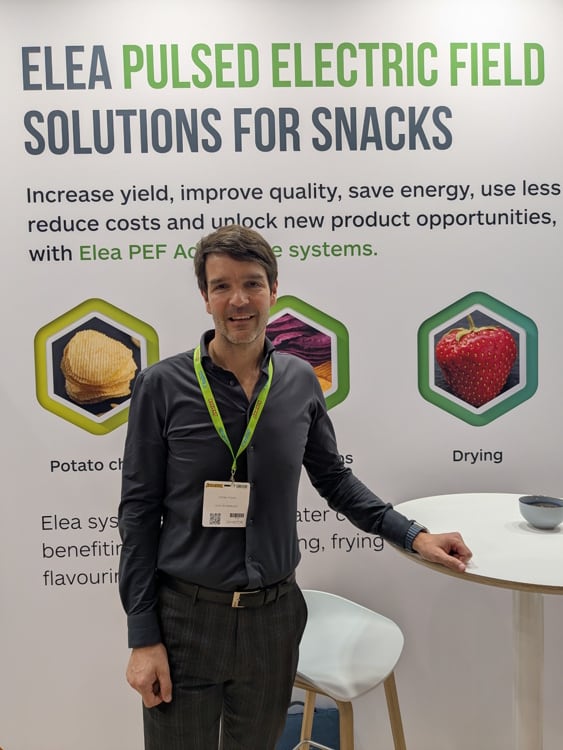
It was one I put to Prof Dr Stefan Toepfl, MD of Elea, when we met at Snackex 2026 – the only international trade fair dedicated entirely to the savoury snacks industry – held recently in Lisbon, Portugal. His response echoed a view I’ve heard with increasing frequency across the food industry: processing should be judged less by the fact that it exists and more by what it’s designed to achieve. “Technology is a tool to achieve a certain goal,” he says.
The factory is becoming the new formulation lab

Healthier snacks have usually been discussed through the language of reformulation, with the focus falling on salt reduction, fat reduction, fibre enrichment, cleaner labels or ingredient swaps. Toepfl believes production technology deserves a much bigger place in that equation.
Elea specialises in pulsed electric field (PEF) technology, which applies short electrical pulses to raw materials before further processing. In potato snacks, the tech gently alters the structure of the potato before slicing and frying, improving cutting behaviour and influencing how the slice performs throughout the rest of the manufacturing process.
Reducing oil or improving nutritional credentials may appeal to consumers, but manufacturers first want to know what a new technology will do for their production lines.
“Health is a side aspect, but it’s more driven by consumers and retailers wanting producers to do that,” says Toepfl. “The cost driver and sustainability driver are driving our clients.”
In practice, new equipment has to demonstrate a measurable commercial return before it reaches commercial scale. It needs to improve yields, reduce waste, lower ingredient costs or make production lines run more efficiently. Once that business case has been established, health and sustainability become additional reasons to invest rather than the primary justification.
Toepfl is equally candid about how sustainability fits into that equation. “Sustainability to me is also mostly triggered by the cost effects of sustainability. If it has a cost, it has an effect. Without a cost, it’s nice to have, but not really something people move on.”
PEF’s commercial case begins with the potato itself. By changing the potato’s cellular structure before slicing, the tech influences almost everything that follows. Moisture movement, slicing performance, oil absorption, breakage, texture and even the appearance of the finished crisp are all affected before the product reaches the fryer. But one of the most immediate gains is improved yield. “We see 1.5% higher yield,” says Toepfl. “Those solids stay inside the slice and are carried over to the final product instead of ending up in the water streams of the slicer.”
While a 1.5% improvement may appear modest, the economics quickly become convincing. Toepfl estimates that increase in yield alone can generate between €150,000 and €200,000 per production line each year, before accounting for lower waste treatment costs, reduced slice breakage and improved process consistency.
Oil absorption is another area where PEF delivers measurable gains. He notes PEF typically reduces oil uptake by around 10% on a relative basis, or by as much as five percentage points in absolute fat content. In practical terms, a crisp containing around 33% fat could potentially be reduced to about 28% without changing the recipe itself.
Toepfl’s figures are increasingly supported by independent research. A 2021 study published in LWT – Food Science and Technology found that PEF pretreatment reduced the oil content of potato chips by 21.2% under optimum processing conditions, while also improving crispness, producing a smoother chip surface and lowering acrylamide levels.
Those findings were reinforced a year later when researchers reported that PEF pretreatment reduced oil uptake in potato chips by up to 17.6%, depending on frying temperature, while also improving colour and working synergistically with vacuum drying to reduce acrylamide formation by as much as 85.9% compared with untreated samples.
Taking it further, a 2022 study investigating French fries found that PEF treatment reduced cutting force by 33%, increased crispness by 64% and lowered crude fat content by 28%, while also improving colour through reduced levels of reducing sugars.
And most recently, a 2025 study on sweet potato kettle chips demonstrated that PEF reduced oil absorption by up to 9% and acrylamide formation by as much as 45%, while maintaining overall product quality.
Lower oil uptake influences far more than the nutrition panel. Oil is one of the most expensive ingredients in crisp manufacturing, affecting production costs, shelf life and overall product quality. In April, the FAO Vegetable Oil Price Index reached its highest level since July 2022. Even after a decline in May, it remained well above year-earlier levels. Volatility in global vegetable oil markets over the past two years – driven by weaker palm oil production, reduced sunflower and rapeseed harvests, growing demand for biofuels and wider geopolitical uncertainty – has only sharpened manufacturers’ focus on using less of it.
The OECD-FAO Agricultural Outlook projects that vegetable oil prices will remain comparatively firm over the coming decade as demand continues to outpace production growth. At the same time, per capita food consumption of vegetable oils is forecast to keep increasing, particularly in emerging economies where processed food consumption is rising rapidly.
Against that backdrop, reducing oil uptake by even a few percentage points becomes more than a nutritional benefit. It lowers ingredient costs, reduces manufacturers’ exposure to commodity price volatility and can improve shelf life by limiting the amount of oil retained in the finished product.
“The oil has a price effect because usually the oil is much pricier than the potato,” says Toepfl. “It also has a shelf life effect because the oil is making the product soggy if there’s too much oil in it.”
Those are benefits consumers rarely think about when they open a bag of crisps, yet they have a direct bearing on the eating experience. A product that absorbs less oil doesn’t just contain less fat; it’s also likely to retain its crunch for longer and feel less greasy. “Consumers benefit from a lower oil content, better colour and better crunch,” he adds.
That thinking runs throughout Toepfl’s approach to processing. PEF isn’t being promoted because it’s new but because it can deliver measurable outcomes: less oil, higher yields, lower waste, better shelf life and improved product quality without changing the recipe itself. Judging every manufacturing technology by the same standard risks overlooking what some of them are actually designed to achieve.
“Perhaps the real question isn’t whether a food has been processed, but whether it has been processed well,” he notes.
Processing isn’t the same as ultra-processing

The UPF debate has forced the food industry to confront uncomfortable questions about formulation, convenience, palatability, portion size and public health. It’s also created a risk that processing and ultra-processing become treated as the same thing. They aren’t.
The UK Food Standards Agency notes that processing can improve taste, texture and shelf life, help make food safer or more affordable, reduce waste and improve nutritional content by lowering saturated fat, sugar or salt. The British Nutrition Foundation has also warned that the NOVA definition of UPFs is broad, capturing many foods that are energy dense and high in fat, sugar and salt, while acknowledging that the mechanisms linking ‘ultra-processing’ itself to health outcomes remain an important area of research.
Toepfl believes purpose should come before perception. “Technology is a tool to achieve a certain goal,” he says. “Food processing has a purpose of converting a raw material into a shelf-stable product.”
That may sound obvious to anyone working in food manufacturing, but it’s increasingly important in a debate that can sometimes treat processing as inherently suspect. Baking, drying, blanching, freezing, fermenting, frying, milling, pasteurising, extruding and electrifying all involve processing, but they do very different things and have very different implications for nutrition, safety, quality and sustainability.
Toepfl sees the industry becoming more open to technology-based solutions, particularly where they can deliver functionality that might otherwise require ingredient changes. “Do you achieve a certain functionality by adding some ingredients, or do you achieve it with the right technology? I think there is a shift towards technology.”
That shift, though, has taken time. Toepfl has worked with PEF for more than 20 years and says the early years were marked by hesitation around new tech and electrically based processing. Thankfully, that scepticism has softened. “Electric energy today is seen as something positive because it can use renewable energy sources and technology is much better accepted,” he says.
Manufacturers are now investing in electrification, renewable energy and process optimisation as part of broader decarbonisation plans. Tech that once sounded unfamiliar can now be framed as part of a lower-carbon, more efficient production system.
However, Toepfl isn’t blind to the criticism coming from the UPF debate. “We do see that there is a hesitation and some criticism about technology coming from that corner. But PEF has always been considered a kind of minimal process – low energy input and little impact on functionality.”
PEF isn’t being used to create an indulgent product from a long list of additives. In this context, it’s being used to improve how a potato is sliced, fried and converted into a finished crisp.
Toepfl isn’t arguing that every form of processing deserves a free pass, but that it should be judged by what it actually achieves. If a process reduces oil uptake, improves yield, lowers waste and uses less energy without altering the recipe, those benefits deserve to be weighed alongside the concerns.
AI is becoming the operator’s second brain

Changing tract, Toepfl sees AI as the natural next step in processing technology. Once manufacturers have invested in equipment such as PEF, the challenge becomes using it to its full potential.
“We do use a lot of AI-based tools,” he admits. This, however, isn’t AI as a shiny corporate slogan but AI being used on the line, where operators are trying to manage increasingly complex systems, changing raw material quality and pressure to keep production running consistently.
Toepfl says Elea uses machine learning to evaluate the impact of PEF on cutting properties, process signals and filter out background noise. That data can then support recommendations around processing parameters, helping operators make better decisions. “Our tools give recommendations. They can recommend what will change on the processing parameters.”
He adds that manufacturers are far more comfortable with AI that supports operators than AI that replaces them. Fully autonomous decision making is still viewed cautiously, whereas systems that analyse production data and recommend changes to processing parameters are already finding acceptance.
That’s a useful reality check for the food industry. AI isn’t simply about replacing people. In many factories, it may prove most valuable as a way of helping overstretched teams manage increasingly sophisticated production lines. “AI tools can help utilise all the benefits of such a new process 24/7, so that a producer is not so much dependent on the training level of the operator,” he notes.
That point will resonate with any producer struggling to recruit and retain skilled operators. Processing technologies only deliver their full value if they’re used correctly, consistently and continuously. AI can help narrow the gap between what a technology is capable of achieving and what actually happens on a busy production line at 3am.
Nor is it confined to PEF. Toepfl says AI is already being used to support water management, monitor factory water streams, optimise loading and help identify energy savings. Deloitte has similarly highlighted AI and machine learning as key enablers of predictive maintenance, helping manufacturers limit downtime by turning data into earlier warnings and better decisions.
That’s where processing technology, data and sustainability begin to converge. A smarter line isn’t just one that runs faster but one that wastes less, uses less energy, responds better to raw material variation and requires fewer manual interventions to maintain quality.
Asked which assumption the snack industry is most likely to get wrong over the next five years, Toepfl doesn’t point to a single technology but a mindset. “We’ve always done it like that.”
That phrase isn’t confined to factories. It’s heard across boardrooms, industry events and policy discussions whenever change begins to feel uncomfortable.
The food industry has spent years trying to answer a familiar question: what can be taken out of the recipe? Increasingly, another question is becoming just as important: what if the recipe isn’t the only place to look?
If tech such as PEF can reduce oil, improve yield, cut waste, support better texture and produce a more consistent crisp without adding a single ingredient, then the next wave of snack innovation may not be written on the label at all. It may be engineered into the process long before the consumer opens the packet.
Studies:
Zhang C, Zhao W, Yan W, et al (2021) Effect of pulsed electric field pretreatment on oil content of potato chips, LWT, Volume 135, 2021, 110198, ISSN 0023-6438, https://doi.org/10.1016/j.lwt.2020.110198
Liu C, Zhang R, Vorobiev E and Grimi N (2022) Mitigation of Acrylamide in Potato Chips by Pre-drying and Pulsed Electric Field Treatment. Front. Nutr. 9:919634. https://doi:10.3389/fnut.2022.919634
Lee SH, Shahbaz HM, Jeong SH, et al (2022) Effect of pulsed electric field treatment on cell-membrane permeabilization of potato tissue and the quality of French fries. Italian Journal of Food Science, 34(3), 13-24. https://doi.org/10.15586/ijfs.v34i3.2180
Skinner MM, Fong MA, Rimkus TP, et al (2025) Pulsed Electric Field Treatment of Sweet Potatoes to Reduce Oil and Acrylamide in Kettle Chips. Foods, 14(4), 577. https://doi.org/10.3390/foods14040577


