


Key takeaways:
- Kellogg’s revival of cereal box toys taps powerful nostalgia but reopens long-standing concerns about marketing directly to children.
- Global regulations on HFSS foods have tightened significantly, making promotional tactics like in-box toys more controversial than when they disappeared.
- While framed as ‘screen-free play’, toys remain a commercial incentive that could influence children’s preferences and prompt wider industry copycat moves.
I used to go straight in with my hand. No bowl, no milk, no patience. Just a quick shake of the box and then rummaging around like I was looking for buried treasure. Sometimes you’d hit the plastic wrapper first and feel cheated. Sometimes you’d pull out the toy straight away and feel like you’d won something. Either way, it was never really about the cereal.
So when WK Kellogg Co announced it was bringing toys back inside cereal boxes for the first time in over a decade – tied to the release of Toy Story 5 from Disney and Pixar – I was transported back.
It’s a smart move, positioned as a celebration of ‘screen-free play’ and shared family moments. It’s hard not to feel a flicker of warmth at that idea as it taps into something emotional, something recognisable, something that feels like a shared childhood language. It also arrives at a time when cereal brands are under pressure to stay relevant with younger families.
But it also made me pause, because the toys didn’t quietly fade away for no reason. They were edged out as people started asking a fairly uncomfortable question: should food – especially the kind aimed at children – come with a built-in incentive?
That question hasn’t gone anywhere. If anything, it’s become sharper, more global and much harder to sidestep.
Why toys disappeared in the first place

The decline of in-box toys was gradual. They just became less common, then rare and then gone. By the late 2000s and early 2010s, regulators and public health advocates were increasingly concerned about ‘pester power’ – the ability of marketing tactics to influence children’s food choices and, by extension, family purchasing decisions.
In the US, where many of these marketing tactics were refined, the change was driven less by hard law and more by pressure. Companies signed up to initiatives like the Children’s Food and Beverage Advertising Initiative, promising to clean up how they marketed to under-12s. No one stood up and said, “we’re banning toys”, but the direction was obvious. If you’re trying to show you take childhood obesity seriously, putting a prize inside a sugary cereal box looks like a contradiction.
Europe took a firmer stance. The UK and EU have spent years tightening the rules around high fat, salt and sugar foods (HFSS), especially when it comes to children. The principle is straightforward, that you shouldn’t be using every tool available to push these products, particularly to audiences who are less able to assess those choices.
Then you had countries like Chile, which went much further and banned the use of toys and cartoon characters in products that exceed certain nutritional thresholds. That approach didn’t stay local for long and became a reference point for policymakers elsewhere.
Australasia sits somewhere in between, with tighter industry codes in Australia and New Zealand limiting how giveaways can be used, particularly where products don’t meet healthier standards. Across Asia, the picture is more fragmented but the pressure is the same. South Korea restricts advertising of certain foods to children at specific times; Singapore has introduced guidelines to curb unhealthy food marketing; China has been tightening oversight of how brands target minors; and in Japan, companies tend to pull back before anyone tells them to.
The result wasn’t a single global ban, but a convergence of pressure points. Toys became more trouble than they were worth.
The world Kellogg’s is stepping back into

What makes this move feel bold is that the environment now is even stricter than it was back then.
In the UK and across Europe, the conversation has moved well beyond advertising thresholds and now takes in the entire ecosystem around these products. It covers where they sit in a supermarket, how they’re priced, how they show up online, and who they’re allowed to speak to. Scotland, too, is joining the ranks, preparing for new HFSS restrictions set to come into force on 1 October, adding further limits on how less healthy products can be promoted and sold. It underlines just how tight the regulatory environment has become, particularly when it comes to anything that could be seen to influence children’s choices.
The World Health Organization (WHO) hasn’t softened its stance either. It has been clear that “exposure of children to the marketing of foods high in fats, sugars or salt is a major factor contributing to childhood obesity,” and it wants governments to go further, not pull back. That includes packaging and promotions, not just traditional advertising.
The scale of the issue explains why. Childhood obesity has increased more than fourfold globally since 1975, according to WHO figures. At the same time, this is still a huge market. Euromonitor puts the global breakfast cereal category at over $50bn, and children’s cereals remain a significant part of that.
In Asia-Pacific, governments are tightening their approach, particularly as digital marketing blurs the line between content and advertising. Physical promotions like toys may feel old-fashioned, but they still sit within that broader concern about influence.
In this context, a toy inside a cereal box isn’t just a toy. It’s a marketing device – one that regulators have spent years trying to limit. Groups like the Obesity Health Alliance in the UK have made that point repeatedly, arguing that promotions aimed at children can influence what ends up in the trolley. That doesn’t mean a toy causes poor diet on its own, but it does play a role in shaping preferences early on.
Nostalgia vs responsibility
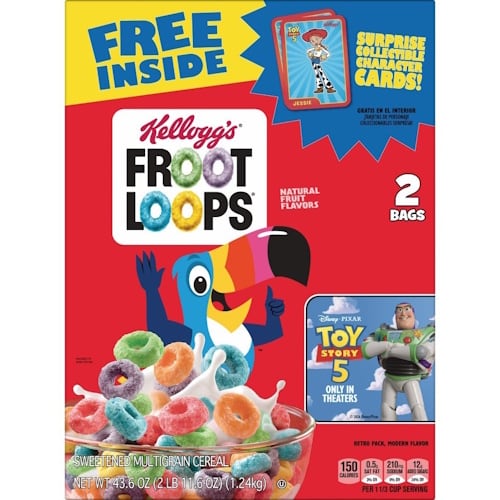
So why now? The answer lies in a convergence of cultural and commercial trends.
First, nostalgia is powerful – and profitable. Millennial parents, many of whom grew up with cereal box prizes, are now the primary buyers. Recreating that experience offers an emotional hook in an otherwise mature category.
Second, the competitive landscape has shifted. Breakfast is no longer dominated by cereal; it’s fragmented across bars, yoghurts, drinks and on-the-go options. Brands need new ways to stand out, and experiential elements – even small ones – can help.
Third, the framing has changed. Kellogg’s isn’t positioning toys as collectibles or incentives to purchase, but as a ‘screen-free’ antidote in a digital world. Parents will pick up those boxes because they remember that feeling and want to pass it on.
“At Kellogg’s, there’s a real sense of childhood nostalgia tied to the moments families remember most – and breakfast is a big part of that,” said Laura Newman, VP Brand Marketing at WK Kellogg Co. “Bringing toys back inside the box reintroduces that sense of discovery through a simple, screen-free moment of play that parents can now share with their own kids.”
That subtly reframes the narrative, aligning the promotion with concerns about screen time rather than consumption. It also gives the partnership a broader cultural footing, positioning it less as a sales tactic and more as a shared experience between generations.
Then there’s the entertainment angle, which leans into that same idea. “At the heart of Toy Story 5 is the idea that toys inspire creativity, friendship and play,” added Lylle Breier, executive VP, Partnerships, Promotions, Synergy & Events at The Walt Disney Studios. “We are delighted to collaborate with Kellogg’s on their Toys Back in the Box campaign that gives families a fun way to explore the playful world of Woody, Buzz Lightyear, Jessie and the gang.”
If I’m being honest, every fibre in me wants this to be fine but I still come back to the same point. It’s an incentive. It gives that product an extra pull, especially for a child. And once that starts working again, it’s hard to see why others wouldn’t follow.
There’s something undeniably charming about the return of the cereal box toy. It taps into a shared cultural memory that feels increasingly rare in a fragmented, digital-first world. But charm doesn’t exist in a vacuum. The same forces that pushed toys out of the box – public health concerns, regulatory pressure, and evolving definitions of responsible marketing – are still very much in play.
Kellogg’s may be betting that a small plastic prize can coexist with modern expectations. Whether regulators, and parents, agree is another question entirely.
Either way, I know exactly what I’d do if I picked up one of those boxes. I’d still tip it sideways and go straight in to find the treasure.


