


Key takeaways:
- Regenerative farming is already working at farm level, but a lack of industry-wide commitment is holding back scale.
- The biggest barrier isn’t practice or proof, but economic confidence and alignment across the supply chain.
- For regenerative to deliver real impact, it must move from niche to default across retail, manufacturing and baking.
Earth Day (22 April) has become a familiar fixture in the food industry calendar – a moment when brands, retailers and manufacturers reaffirm their environmental commitments: soil health, biodiversity, carbon reduction. This year’s theme, ‘Our Power, Our Planet’, leans heavily into collective responsibility.
Strip away the messaging, though, and a more uncomfortable question emerges: if regenerative agriculture is already delivering, who’s holding it back?
Because the reality is, this isn’t new anymore. The practices are known, the results are there and farmers are already doing it. What’s missing is scale, alignment and, frankly, follow-through.

Bertie Matthews, MD of Matthews Cotswold Flour, one of the UK’s oldest family-run flour mills, doesn’t bother dressing that up. “The sector doesn’t have a supply problem, it has a commitment problem,” he says. “Make it the default, not the niche.”
That one line cuts through years of industry noise. If regenerative agriculture is still being treated as a premium add-on in 2026, the issue isn’t farming. It’s the system around it.
Stop calling it regenerative if you can’t prove it

One reason the conversation feels stuck is that ‘regenerative’ has been stretched to mean almost anything. “At farm level, regenerative agriculture is about measurable change, not ideology,” emphasises Matthews. “It means improving soil health through practices like reduced tillage, cover cropping, diverse rotations, and more precise use of inputs.”
He moves quickly from definition to accountability. “This isn’t a pilot anymore, this is already happening and it’s scaling. For us, it’s simple: if the soil, the crop and the farm business are all improving over time and we can evidence that, then it’s regenerative.”
That word – evidence – is doing the heavy lifting here. Because without it, regenerative risks becoming the next overused label the industry quietly moves on from.
“This isn’t about changing flour, it’s about fixing the system behind it,” Matthews adds. And that’s where things get more uncomfortable: fixing the system means rethinking how grain is bought, priced, traced and valued, not just how it’s grown.
To back that up, the 200-year-old business has built its own audit framework, tracking 42 data points linked to soil health, inputs and resilience. “Our role isn’t just to build the system with farmers, it’s to stand behind it with evidence the market can trust. It’s independently audited, open to challenge and continuously refined.”
In other words, if you can’t measure it, you probably shouldn’t be marketing it.
Farmers aren’t the problem, economics are

If there’s one myth Matthews is keen to dismantle, it’s the idea that farmers are slow to change. “The biggest barrier is economic confidence. Farmers won’t change systems at scale unless they know it works financially. And if it doesn’t, we don’t have food security in the UK.”
That’s the part of the regenerative conversation that still doesn’t get enough airtime. It’s often framed as an environmental upgrade, when in reality it’s a commercial decision.
“If it doesn’t work for the farmer financially, it doesn’t exist, no matter how good it sounds on paper,” he continues. “If we want to grow food in the UK, it has to stack up financially.”
He points to the tangible gains: healthier soils that hold water better, more resilient crops and, critically, lower reliance on volatile inputs like fertiliser. “Reducing reliance on inputs directly improves the farmer’s bottom line and reduces exposure to global volatility.”
That’s not a sustainability pitch: it’s a business case.
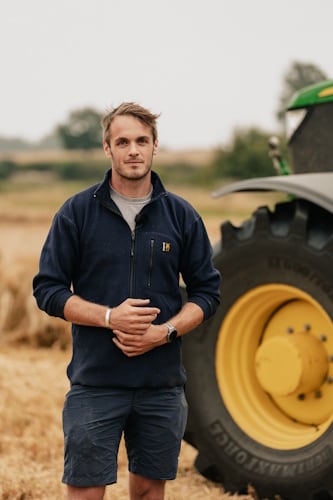
That argument is already playing out on farm. Ed Horton, part of the Cotswold Grain Partnership, says the shift to regenerative practices was driven as much by economics as environment.
“We work very closely with Matthews Cotswold Flour, providing them with durum wheat, spelt and milling wheat. Our regen journey started about ten years ago, when I returned to the family farm,” he says.
“In a challenging economic environment, we needed to make ourselves more financially sustainable for the long term, but we also wanted to provide space for biodiversity, protect water quality and improve soil health. Our partnership has enabled us to do this and, alongside the environmental progress, we’ve reduced the risk exposure linked to high inputs such as fertilisers.”
For Horton, that combination is what makes the model viable. “I would encourage all farmers to look for ways to move towards a regenerative model.”
But even that needs a functioning route to market. According to Matthews, “our role is to remove that uncertainty: giving farmers a clear route to market, practical steps and access to real data and peer-to-peer learning. That’s how confidence builds.”
The second issue is less talked about but just as damaging: fragmentation. “Retailers are starting to move, which is positive, but it’s critical they align with farmers, millers and those already doing the work, rather than adding more complexity through disconnected standards.”
Put bluntly, the industry risks overcomplicating something that already works.
The real win is to make it ‘boring’

There’s an irony at the heart of regenerative agriculture. The goal isn’t to keep it exciting, but to make it ordinary. As long as regenerative flour sits in a premium corner of the market, it won’t deliver the systemic change Earth Day conversations keep calling for.
For bakers, that shift starts with performance. “Bakers expect consistency, quality and flour that delivers every time. That’s a given,” says Matthews.
Only once that’s secured does regenerative add its second layer of value. “Through a fully linked supply chain, that flour can be traced back to the farm, how it’s grown and the standards behind it.”
That traceability connects environmental outcomes to a finished product in a way consumers can understand. “It creates a more valuable product – one that performs technically, carries a clear story and reflects a better farming system.”
Still, none of it works without alignment. Retailers need to back it. Plant bakeries need to scale it. Artisan bakers need to communicate it.
“If the demand is real, the transition will happen,” Matthews says.
And that’s the challenge Earth Day 2026 should really be asking: not whether regenerative agriculture works, but whether the industry is willing to build a system that lets it.
Earth Day 2026 – action, not slogans
Earth Day lands today with a renewed focus on accountability, putting pressure on industries to demonstrate measurable progress rather than long-term ambition.
Across the UK, activity spans farm-level initiatives and industry commitments. Organisations including the National Farmers’ Union continue to push net zero targets for agriculture by 2040, while retailers and manufacturers are increasingly linking sourcing policies to soil health, biodiversity and Scope 3 emissions.
At the same time, regenerative agriculture is moving from pilot to procurement. Several major food businesses and retailers have begun integrating regenerative criteria into supply contracts, particularly for wheat, dairy and fresh produce, though definitions and standards remain inconsistent.
That’s why the Earth Day’s focus this year is shifting from pledges to proof. For food producers, that means demonstrating measurable change – not just talking about it.