


Key takeaways:
- As sleep becomes a top global health priority, bakery and snack brands are turning to L-theanine to offer gentler functional benefits without overstimulation.
- Once confined to supplements, L-theanine is gaining traction in familiar snack formats as consumers seek balance, recovery, and support woven into everyday eating.
- Consumer demand for clear, simple benefits is opening the door for nootropics like L-theanine to move into mainstream bakery and snack categories.
L-theanine has been around for decades. What’s changed is how widely it’s now being used.
As snack brands look beyond energy and protein, more products are turning to nootropics – ingredients positioned around focus, balance and mental wellbeing. L-theanine, long associated with green tea and supplements, is increasingly appearing in bars, chocolate, breakfast clusters and baked snacks as brands respond to consumers who want support without overstimulation.
Consumers aren’t rejecting energy. They’re rejecting edge – the jittery highs, the sense that every product is trying to push them harder. L-theanine fits neatly into that backlash. It offers steady focus rather than stimulation, balance rather than buzz. And right now, that distinction matters.
Science has backed the compound’s effect for years. Research published in Nutrients and The Journal of Functional Foods links L-theanine to a relaxed but alert state, without sedation. Unlike many nootropics, it also comes with low consumer friction: tea-derived, familiar and relatively easy to explain.
What’s new is the cultural context. Sleep has moved from background concern to front-line health priority, and food brands are responding.
From supplement shelf to snack format

Snack brands were the first to make the jump. In the US, MOSH and the Jonas Brothers-backed Mindright Snacks both introduced L-theanine into their bar ranges in 2023, pairing it with magnesium or B vitamins and framing the benefit around balance rather than boost. The message was simple: eat, reset, move on.
Chocolate followed. Good Day Chocolate’s Calm range has been on the market since late 2022, delivering L-theanine in bite-sized pieces. Lagoon entered the space in 2024 with Night Bites – dark chocolate squares blended with magnesium and promoted as a sleep-friendly indulgence.
The idea itself isn’t entirely new. Nestlé trialed a sleep-oriented chocolate product, Goodnight, back in 2019. It failed to gain traction, largely because it sat awkwardly between treat and supplement. At the time, consumers weren’t especially receptive to either.
That line looks different now.
Some brands are leaning further into indulgence. Deux, best known for functional cookie dough, launched cinnamon-glazed baked bites in 2025 under the Deuxnuts name, adding L-theanine and B12 for what it called a ‘focus-forward’ proposition. As of early 2026, the products remain available via direct-to-consumer and selected retail, suggesting the positioning has stuck.
Cereal and bakery manufacturers are moving more cautiously. Post Consumer Brands tested the waters in 2023 with Sweet Dreams cereal. It didn’t include L-theanine, opting instead for chamomile, zinc and vitamin B6, but the signal was clear: sleep-support messaging had entered breakfast – a category historically anchored around fiber, grains and immunity.
Baked goods pose additional hurdles. Moisture, texture and shelf life leave less room for error, and L-theanine can complicate formulation. Still, early launches show it can work. In Australia, Mindfull Co launched a green tea–infused oat cookie in late 2024. Elsewhere, startups in North America and Asia-Pacific are quietly piloting soft-baked formats.
In Japan, this is far from experimental. Matcha cookies, green tea buns, even noodles rich in naturally occurring L-theanine have long been part of the mainstream. Calm-through-food is culturally understood, not marketed.
Regulation shapes the picture. In the US, L-theanine is classified as GRAS, making it relatively straightforward to use across food formats. In Europe, synthetic L-theanine is treated as a novel food, pushing many brands toward green tea extracts instead. That extra friction has slowed adoption but not stopped it.
Why sleep changed the equation

The renewed interest in L-theanine isn’t just about formulation. It’s about priorities.
According to data from Lumina Intelligence, sleep now tops the list of global health goals – ranking ahead of longevity and stress management. In the 2024 survey of 6,000 consumers across the US, Europe and Asia, 54% said ‘getting better sleep’ was their primary wellness objective. Sleep is no longer a night-time niche or a supplement-only concern. It’s increasingly bound up with ideas of recovery, balance and everyday performance.
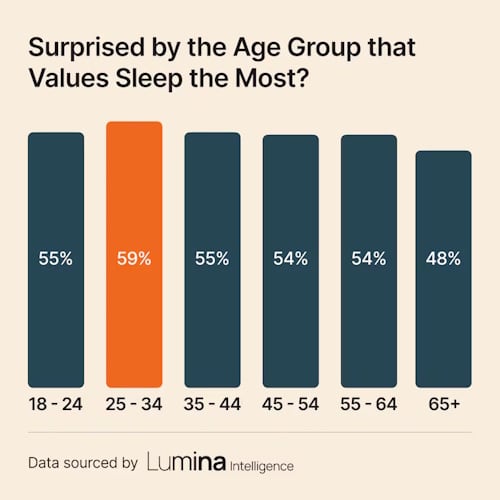
Flora Zwolinski, insight lead at Lumina Intelligence, says the finding emerged unexpectedly from broader research into ultra-processed foods and food technologies.
“One of the questions asked was what consumers’ health goals were and sleep came out as the most commonly mentioned,” she says. “It was an interesting finding that led to recommendations around the opportunity for products targeted at better sleep.”
That gap between consumer desire and product focus is where food – not supplements – may have an advantage.
“From the research, better sleep is clearly something consumers across the globe desire, and there is undeniably a huge opportunity to go after this,” Zwolinski says. “Of course, supplements are available, but many consumers don’t know where to look or which ones to take, let alone even think about taking supplements to support sleep.”
Instead, she argues, everyday categories may offer a more intuitive entry point. “Personally, I think there is a gap in the market for mainstream products and categories to be innovated and fortified with ingredients that are targeted at improving or supporting sleep, whether that’s L-theanine or others.”
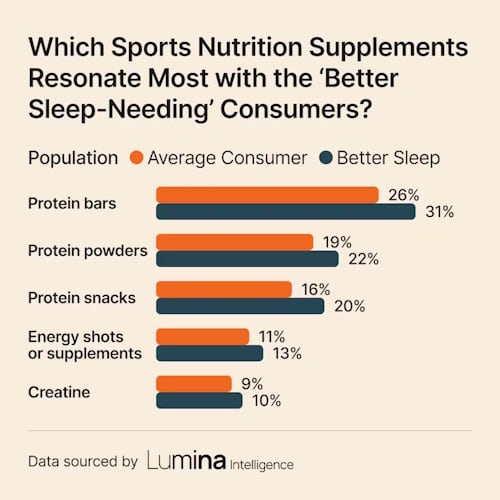
Lumina’s data supports that logic. Consumers who say they need better sleep are more likely to engage with protein bars and sports nutrition formats, and nearly 40% of this group uses health-tracking apps – suggesting awareness and intent but not necessarily supplement reliance. At the same time, a third of sleep-needing consumers say they never use probiotics, despite growing discussion of the gut-brain-sleep connection. For Zwolinski, that reinforces the appeal of simpler, more familiar ingredients delivered through everyday foods.
“We know consumers want clear and simple messaging, and products that have specific nutritional or health benefits that aren’t overly processed and packed full of artificial ingredients they don’t recognize. Consumers genuinely want better sleep, so there is undoubtedly an opportunity for the market to innovate with products that can help them reach that goal.”
Delivered through familiar formats – a biscuit, a bar, a piece of chocolate – L-theanine feels less like an intervention and more like a practical adjustment to daily routines.
Mood-led snacking gathers pace

The turn toward sleep and balance is also changing how consumers emotionally connect with snacks.
Givaudan’s pan-European consumer research, based on responses from 79,000 consumers, points to a shift away from pure indulgence toward lighter emotional cues such as refreshment, energy and uplift. According to Jeremy Roque, consumer & market insights innovation manager for Taste & Wellbeing, pleasure itself is being redefined.
“What’s really clear is that consumers are redefining pleasure,” Roque says. “They still want indulgence, but they want it to come with a sense of vitality and wellbeing.”
That recalibration is particularly relevant for functional ingredients like L-theanine, which don’t promise intensity or transformation, but instead support more subtle emotional needs. Rather than chasing novelty for its own sake, Givaudan’s data suggests consumers respond best when products make sense for a specific moment or mindset.
Flavor still matters, but it’s no longer the sole driver of emotional engagement. Roque argues that intent has overtaken individual components, with products judged on how well flavor, texture, color and function work together.
“When flavors, colors, ingredients and texture work together, people enjoy the product more because it fits their expectations,” he says. “In practice, that creates a more rewarding experience from the first bite or sip. It enhances liking and can increase purchase intent.”
Those expectations aren’t universal. Emotional cues vary sharply by market, reinforcing the need for local nuance. In Italy, emotional connection is closely tied to authenticity and wellbeing. In Germany, fun and experimentation dominate. In parts of Eastern Europe, functional signals such as energy and digestion carry more weight.
That variability makes flexible ingredients particularly valuable. L-theanine can be framed around balance, refreshment or recovery depending on context, without requiring wholesale reformulation – a useful trait as brands rethink how snacks are meant to make people feel.
L-theanine 101
Found in: Green tea
Used for: Focus support, calm energy and stress reduction
Formats: Bars, chocolate, cereals, baked goods
Popular since: 2022-2025 surge in food and beverage applications
Claim framing: Not sedative, not stimulating: something in between
Regions to watch: US (GRAS status), Japan (longstanding), EU (limited use without green tea base)
Quiet ingredients, strategic role

L-theanine is unlikely to anchor a brand or redefine a category. But that’s not its job.
Its strength lies in subtlety. In a functional market crowded with big promises and rising skepticism, restraint is an asset. L-theanine allows bakery and snack brands to speak to mental wellbeing and sleep-adjacent needs without sounding medicinal or overpromising results.
The products most likely to succeed won’t shout. They’ll fold naturally into daily routines – a breakfast biscuit, a mid-afternoon bar, an evening snack that doesn’t push too hard in either direction.
That may not look like disruption. But right now, it’s exactly what consumers are asking for.
FoodNavigator-USA: Healthy snacking trends webinar
Nearly 90% of consumers snack daily – whether to fit around busy schedules, carve out small moments of reset, or connect with others. But what they’re reaching for is changing.
As motivations evolve, so do expectations around snack formats, flavors, and nutrition. FoodNavigator-USA’s upcoming Healthy Snacking Trends webinar, airing January 21, 2026 at 10am EST/3pm GMT, will explore how modern shoppers are redefining the snack aisle.
The session will examine which categories are gaining momentum, which ingredients and dietary priorities are shaping innovation, and how brands and retailers are adapting their marketing and merchandising strategies in response.
Hosted by senior editor Elizabeth Crawford, the panel will feature insights from experts at Danone, Chobani, the Hartman Group, and the Almond Board of California, among others.
Studies:
David J White, Suzanne De Klerk, William Woods, et al. Anti-Stress, Behavioural and Magnetoencephalography Effects of an l-Theanine-Based Nutrient Drink: A Randomised, Double-Blind, Placebo-Controlled, Crossover Trial. Nutrients 2016, 8(1), 53; https://doi.org/10.3390/nu8010053
Ming-Yue Li, Hong-Yan Liu, Ding-Tao Wu, et al. L-Theanine: A Unique Functional Amino Acid in Tea (Camellia sinensis L.) With Multiple Health Benefits and Food Applications. Front. Nutr., 04 April 2022. Sec. Food Chemistry. Volume 9 - 2022 | https://doi.org/10.3389/fnut.2022.853846